









Burncoin Tokenomics
Burncoin ($BURN) is a deflationary token on the Solana blockchain with a fixed total supply of 21 million tokens, designed to increase scarcity over time through a 4.20% burn tax on every swap and wallet transfer. Below is an overview of its token distribution, burn mechanism, and key economic features.
Token Distribution
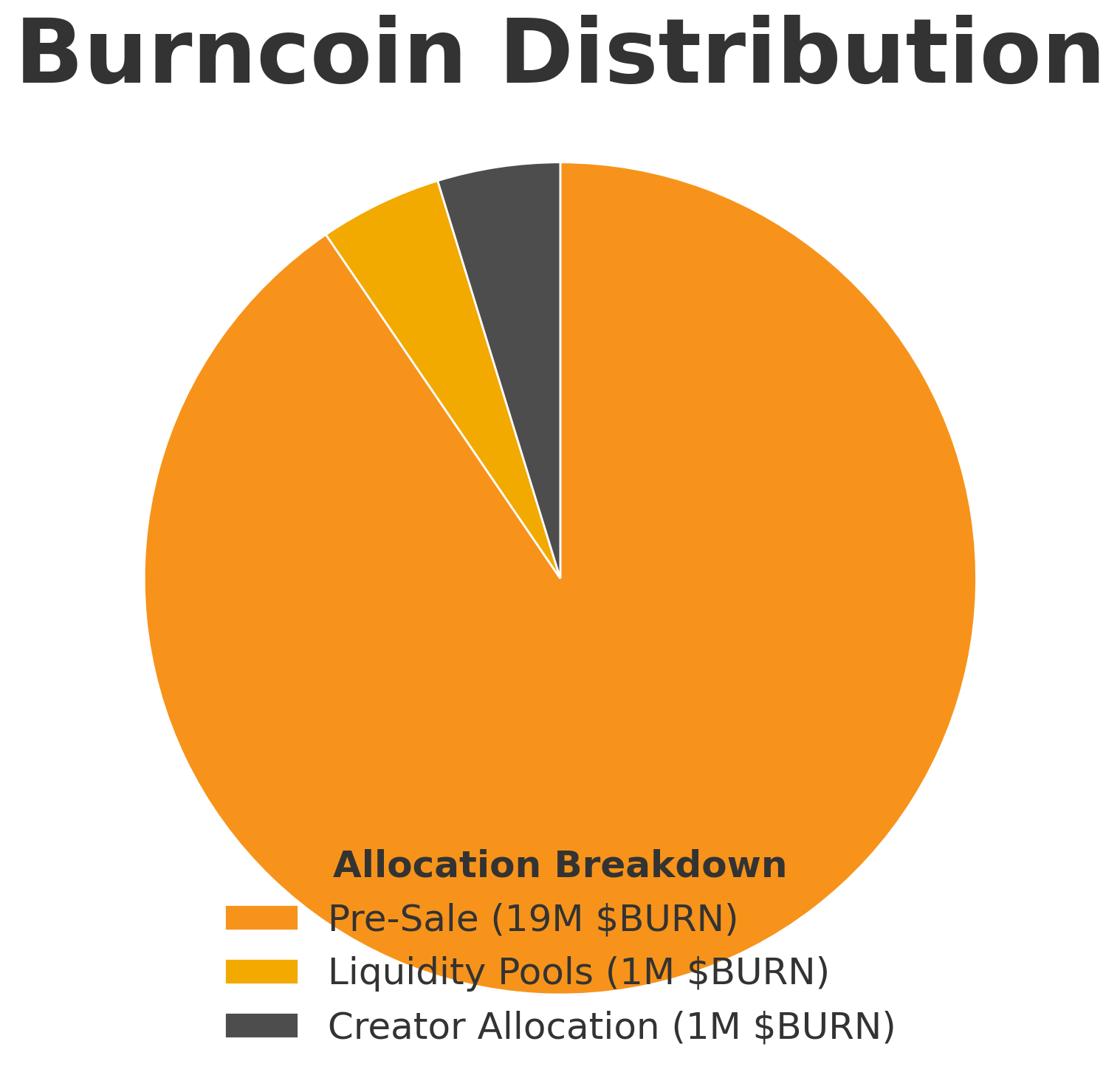
The total supply of 21 million $BURN was distributed as follows during the fair launch from April to June 2025:
- 19 million $BURN (90.48%): Distributed to the public via a fair Dutch auction (completed).
- 1 million $BURN (4.76%): Reserved for initial liquidity pools, paired with $SOL and locked permanently at launch. View the contributions and locks.
- 1 million $BURN (4.76%): Allocated to the creator, locked for one year until April 8, 2026. View the lock transaction.
Why 1 Million $BURN Was Allocated to Liquidity
None of this is financial advice.
At launch, 1 million $BURN (4.76%) was paired with $SOL and permanently locked to form the initial liquidity pool. This amount was carefully chosen, not randomly.
Many memecoin traders gravitate toward smaller liquidity pools because they allow for higher price movement, both up and down. In contrast, tokens with very large liquidity pools and low market caps, like $CWIF at one point ($1M+ LP vs $3M market cap), often struggle to attract degens looking for volatility.
$BURN was designed to strike a better balance. While some liquidity is necessary for stability and confidence, too much can weigh down growth, especially in deflationary tokens like Burncoin, where coins outside the LP burn but LP supply remains balanced.
The result is a leaner liquidity pool that still enables trading while giving $BURN room to move and burn outside of the LP. This intentional design choice aligns with what many in the memecoin community value.
Distribution Breakdown
Dutch Auction Presale
The Burncoin presale, conducted from April 2025 to June 2025, utilized a Dutch auction format to ensure fairness. The auction started with an implied market cap of approximately $30 million, decreasing to $100,000 by the end. This structure allowed participants to pay the highest price they believed $BURN was worth, eliminating insider advantages and ensuring a transparent, community driven launch.
Why a Dutch Auction Presale?
A Dutch auction, also known as a reverse auction, starts with a high initial price that gradually decreases over time until the allocation is sold or the auction ends. This method ensures fairness by allowing all participants to bid at the price they believe the token is worth, preventing early insider deals or preferential allocations. Burncoin’s Dutch auction presale was designed to create a level playing field, with no venture capital or hidden team allocations, fostering a community driven launch.
The concept of a Dutch auction is endorsed by Solana cofounder Anatoly Yakovenko, who has publicly supported it as a fair method for token distribution. His advocacy highlights its transparency and alignment with decentralized principles.
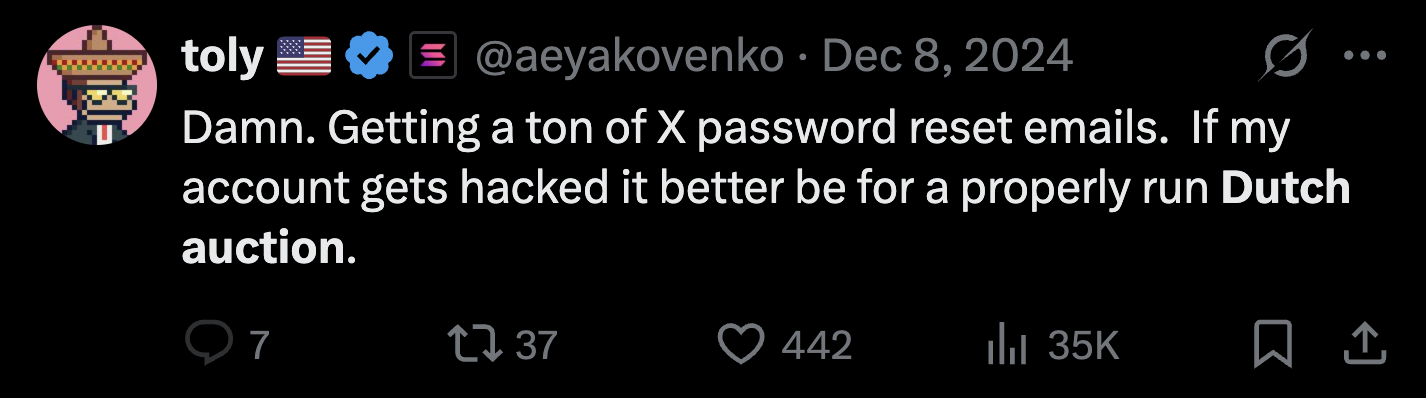
A properly run Dutch auction? Burncoin’s got it. Solana Co-Founder Anatoly Yakovenko supports Dutch auctions as a fair launch method.
Burn Statistics
The 4.20% burn tax on all wallet transfers and DEX swaps is active and permanent. The charts below combine historical Birdeye observations with current on chain observations from Helius.
Daily Supply Burns
Daily burns are calculated from changes in the reported total supply. Missing days usually mean the upstream supply source did not publish a new value; its update frequency can vary. Historical observations come from Birdeye. New observations come from Helius.
$BURN Supply Remaining (Helius)
Current $BURN supply remaining (Helius). The dotted bridge connects the final Birdeye observation to the first Helius observation. Different supply sources may use different calculation methods, so values at the transition may not match exactly. Historical observations come from Birdeye. New observations come from Helius.
Key Tokenomic Features
- Fixed Total Supply: 21 million $BURN, with no Mint Authority, ensuring no additional tokens can ever be created.
- 4.20% Burn Tax: Enforced via Solana Token Extensions, 4.20% of every wallet transfer and DEX swap (e.g., Jupiter, Raydium) is permanently burned, reducing the circulating supply over time.
- No Freeze or Fee Withdraw Authority: The protocol is fully decentralized, with no ability to freeze tokens or withdraw fees.
- Fair Launch: No hidden team wallets or allocations. The Dutch auction ensured broad distribution, and liquidity was locked to support trading.
- Powered by Solana: Built on Solana for fast, low cost transactions and scalability.
How the Burn Works
Every transaction involving $BURN, whether a wallet transfer or a swap on decentralized exchanges like Jupiter or Raydium, incurs a 4.20% burn tax. This tax is automatically deducted and permanently removed from the supply, enforced by Solana Token Extensions. Over time, as transactions occur, this mechanism increases the scarcity of $BURN, distinguishing it from other cryptocurrencies.
Where does the 4.20% fee go? 🔥
$BURN uses Solana Token Extensions to apply a 4.20% burn fee on every DEX swap and wallet transfer. There is no traditional “burn wallet.” Instead, the fee is locked so that only Solana’s default burn address can withdraw it, meaning no one can ever access or recover the burned tokens.
That means every fee is permanently burned and gone forever.
Verify for yourself on Solscan.
Additional Tokenomics Data
The charts below provide further insights into the Burncoin presale and liquidity, complementing the tokenomics overview.
$BURN's 2025 Presale
The Burncoin presale, conducted from April 2025 to June 2025, utilized a Dutch auction format to ensure fairness. The auction started with an implied market cap of approximately $30 million, decreasing to $100,000 by the end. (Data from Helius.dev queries)
$BURN DEX Liquidity ($USD)
View the 1M $BURN contributions and locks. Contribute your own liquidity on Raydium to potentially earn APR. Historical liquidity comes from Birdeye. New observations total six verified Raydium and Meteora pool balances from Helius across SOL, USDC, BRNS, and PEPE pairs. USD conversion uses DEX Screener. Different providers can calculate liquidity differently, so values at the transition may not match exactly. The current partial UTC day updates every four hours.